project outcome
Digital Building Permit booklet
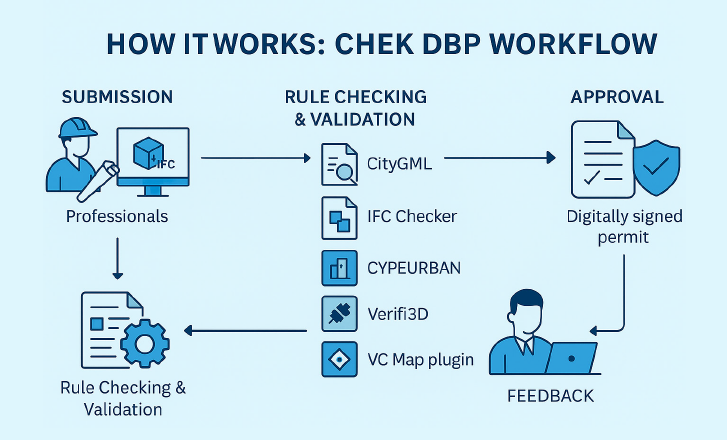
CHEK project envisioned a future where automation, transparency, and standardization are the norm. The project promoted a modular and standards-based Digital Building Permit (DBP) ecosystem, interoperable across cities, scalable across the EU, and understandable by humans and machines alike.
This booklet introduces the achievements of the CHEK project—Change Toolkit for Digital Building Permit. It provides municipalities, urban planners, professionals, and policy stakeholders with a clear, engaging overview of how digital building permit systems can transform permitting practices across Europe.
Scientific development
At the core of the CHEK project is a strong foundation of scientific research aimed at modernizing and simplifying the building permit process through digital innovation. The project brings together expertise from architecture, engineering, planning, computer science, and public administration to develop a new, smarter way of managing building approvals.
CHEK focuses on turning complex planning rules and building codes into formats that computers can understand and check automatically. The scientific work behind CHEK also includes the development of tools that ensure data quality, allow digital signatures on IFC models, and convert city models from one format to another.
All research outcomes whether data models, rule-checking tools, or software prototypes are shared openly to encourage learning, collaboration, and further development. This approach supports open science and helps cities across Europe adopt modern, efficient, and digital-ready workflows for building regulation.

Generated sample datasets
| Data | Purpose | Repository |
|---|---|---|
| 3D city models generated in CHEK | Support 3D city model-related developments | Github, Zenodo |
| Sample data to exemplify CHEK CityGML | Support CHEK CityGML and related tools developments, including GeoBIM conversions | Github, Zenodo |
| Sample data to exemplify CHEK IFC | Support CHEK IFC and related tools developments including GeoBIM conversions | Zenodo |
| BIM for demonstration scenarios | Support CHEK demonstrations | Zenodo |
Change supporting tools and CHEK results
| Data | Purpose | Repository |
|---|---|---|
| CHEK To-be process map D1.1 | Design the CHEK process supporting platform and plan the change in municipalities | Zenodo |
| CHEK Maturity model D1.2 | Support digitalization of building permitting maturity assessment | |
| CHEK roadmap D1.2 | Support planning building permit digitalization actions | Attached to the deliverable available on the CHEK website |
| CHEK Level of Information Need | Specify data requirements and support standard data model profiles definition | Zenodo |
| bSI Use Case Management document for digital building permit | Collect process and data and systems requirements in a standardized format | Waiting for final approval |
| CHEK IFC D2.2 | IFC data requirements definition and validation | Github |
| CHEK CityGML D2.3 | CityGML data requirements definition and validation | |
| Demonstration scenarios results D6.2, D6.3, D6.4 | Demonstrate and validate CHEK developments | |
| Best practices and scalability guidelines D6.5 | Summarize and disseminate lessons learnt from demonstrations and the project overall | Zenodo |
| GeoBIM best practices D.3.4 | GeoBIM best practices | Zenodo |
Software development

CHEK’s DBP software stack
CHEK delivers a suite of interoperable software tools that support every stage of the digital building permit processes spanning from design phase to regulatory review. Built on open standards like IFC and CityGML, these tools are modular, practical, and designed to meet the real needs of both designers and municipalities.
CHEK’s DBP software stack is result of joint effort, a cross-disciplinary collaboration in order to deliver practical, scalable, and innovative solutions that advance the digitalization of permitting processes across Europe.
| Data | Purpose | Repository |
|---|---|---|
| CHEK Change Management Virtual Assistant D1.3 | Support digitalization level assessment and consequent planning of building permit digitalization actions | |
| CHEK data validity-supporting tools D2.4: CityJSON validator (OGC Data Exchange Toolkit + Val3dity) | Validate if the GIS/CityJSON models include valid geometry and the required attributes |
Live application on a demo server: link |
| CityGML validators connection to BIM service. center | BIMServer Connector to Val3dity and OGC validators and report visualisation | Github Link |
| CHEK data validity-supporting tools D2.4: CHEK IFC exporters | Export CHEK IFC-compliant BIM from Revit and ArchiCAD | Revit IFC Exporter, ArchiCAD IFC Exporter |
| Geo to BIM converter D3.1 | Provide the designers with data about the context | Source Code, Executable, IfcEngine, GISEngine |
| IFC georeferencing tool D3.2 | post-processing to adjust IFC models in desired CRS | Github |
| BIM to Geo converter D3.3 | Extract a set of building envelopes (inc. relevant semantic data) from an IFC model to allow analysis on a city scale/ incorporation in city scale models | Github |
| IfcGeoJSON | Conversion of IFC models to GeoJSON with georeferencing support for direct visualisation on GIS tools | Github |
| CHEK process management platform D4.3 | Support the building permitting process | BIMserver.center |
| BIMservice.center Open APIs D4.4 | Document the API to be able to be used by third parties | Link |
| IFC digital signature module D4.5 | Digitally sign submitted IFC models | Link |
| IFC-based checking software D4.6 | Automation or semi-automation to check buildings geometrical rules with a building model in IFC | CYPEUrban, CYPE Accessibility, CYPE OpenBIM Site |
| CityGML-based checking software D4.8 | Automation of checking building designs against rules that require geolocation and geospatial context information |
(requires BIMserver.center account for login/connection with the DBP platform) |
| 3D City Database 5.0 | Storage and management of CityGML data; supports CityGML 1.0, 2.0, 3.0 as well as CityJSON | Github |
| CHEK Validation Results Viewer | This is a lightweight Flask-based web application for uploading, validating, and visualizing CityJSON files. It leverages the CHEK Validator to validate CityJSON data against SHACL profiles and converts the data to a GLB format for 3D visualization | Github |
Documentation, education and training
| Data | Purpose | Repository |
|---|---|---|
| Software workshops and documentation D4.9 | Support software use | Youtube link |
| Wiki of DBP D5.1 | Merge the DBP knowledge, including the glossary, in an accessible wiki platform conversions | CHEK Wiki |
| Glossary of DBP terms D5.1 | Support the interchange of information by providing a set of terms and definitions based on the partners integrated knowledge | Glossary |
| Training materials (documents, videos, course) + platforms such as moodle (D5.2 and D5.4) |
Enable stakeholders to actively take part in the building permit digitalization and use the developed systems for the goal of CHEK demonstration |
Communication & Dissemination
Conference Papers & Publications
| Title | Authors | Conference |
|---|---|---|
| Open-Source Libraries for Digital Building Permit Rules Verifications – Pilot Project | Ivanova, V., Saura lorente, G., & Koutra, S. | eduBIM2023. 9ème édition des Journées de l’enseignement et de la recherche autour du BIM et la maquette numérique |
| OGC Data Exchange Toolkit: Interoperable and Reusable 3D Data at the End of the OGC Rainbow | Noardo, F., Atkinson, R., Simonis, I., Villar, A., & Zaborowski, P. | In International 3D GeoInfo Conference (pp. 761-779). Cham: Springer Nature Switzerland |
| Assessment of the LoD specification for the integration of BIM-derived building models in 3D city models | van der Vaart, J., Stoter, J., Diakité, A., Biljecki, F., Ohori, K. A., & Hakim, A. | In International 3D GeoInfo Conference (pp. 171-191). Cham: Springer Nature Switzerland. |
| Development of a geo to BIM converter: CityJSON importer plugin for Autodesk Revit | Hakim, A., der Vaart, J. V., Ohori, K. A., & Stoter, J. | In International 3D GeoInfo Conference (pp. 249-263). Cham: Springer Nature Switzerland. |
| Integrated GeoBIM Requirements Definition for Digital Building Permit | Mastrolembo Ventura, S., Comai, S., Noardo, F., Raj, K., & Ciribini, A. | In CONVR 2023-Proceedings of the 23rd International Conference on Construction Applications of Virtual Reality (pp. 526-537). Firenze University Press. DOI: 10.36253/979-12-215-0289-3.51 |
| Profiling Standards to Improve Practical Interoperability | Noardo, F., Atkinson, R. A., Villar, A., Zaborowski, P., & Simonis, I. | The International Archives of the Photogrammetry, Remote Sensing and Spatial Information Sciences, 48, 359-366 |
| Enhancing Georeferencing of IFC Models through Surveyed Points Integration | Hakim, A., Arroyo Ohori, K., van der Vaart, J., El Yamani, S., & Stoter, J. | The International Archives of the Photogrammetry, Remote Sensing and Spatial Information Sciences, 48, 41-47 |
| Digital Building Permit Conference 2024 – Proceedings | Noardo, F., & Fauth, J. | Digital Building Permit conference 2024, Barcelona |
| Definition of information requirements for the (semi-)automation of building height verification in Italian. | Digital Building Permit Conference 2025, Vienna | |
| Interpretation of building regulations by using an AI-based virtual assistant | Digital Building Permit Conference 2025, Vienna | |
| Defining LoDs to support BIM-based 3D building abstractions in GIS | Selper conference on geoinformation 2025m Mexico, Merida, |
Journal Papers & Publications
| Title | Authors | Journal |
|---|---|---|
| Digital Transformation of Building Permits: Current Status, Maturity, and Future Prospects | Ataide, M., Braholli, O., & Siegele, D. | Buildings (2075-5309), 13(10). |
| Taxonomy for building permit system-organizing knowledge for building permit digitalization | Fauth, J., Bloch, T., Noardo, F., Nisbet, N., Kaiser, S. B., Gade, P. N., & Tekavec, J. | Advanced Engineering Informatics, 59, 102312 |
| Investigating building permit processes across Europe: characteristics and patterns | Fauth, J., Nørkjær Gade, P., Kaiser, S., Raj, K., Goul Pedersen, J., Olsson, P. O.,. & Tekavec, J. | Building Research & Information, 53(4), 417-434 |
| A Validated Framework for Assessing Digital Building Permit Maturity | Braholli, O.; Fauth, J.; Noardo, F.; Ataide, M.; Urban, H.; Raj, K.; Mastrolembo Ventura, S.; Tekavec, J. | Preprints 2025, 2025091556 |
| Definition of standardised GeoBIM information requirements for digital building permits (Under review) | Comai, S., Noardo, F., Mastrolembo Ventura, S., Bolpagni, M., El Yamani, S., Raj, K., Stoter, J., Ciribini, A. | Journal – Building Research and information |
| A Methodology to Convert Highly Detailed BIM Models into 3D Geospatial Building Models at Different LoDs | van der Vaart, J.; Arroyo Ohori, K.; Stoter, J. | Preprints 2025, 2025092284 |
| CHEK Validation Results Viewer: A Web Application for Validating and Visualizing CityJSON Models Using OGC CHEK Building Profiles (Under Review) | Akin, A.T., Villar, A., Diakite, A., El Yamani, S., Stoter, J., Noardo, F., Atkinson, R., Zaborowski, P. | |
| Navigating the shift towards sustainable digital building permits and building logbooks | Lavikka R, Fauth J, Toscano M et al. | Open Res Europe 2025, 5:90 |
| An Open and Standards-Compliant Platform for Product Data Templates in Digital Construction | El Sibaii, M., Granja, J., & Azenha, M. | Journal of Information Technology in Construction (ITcon), 30(28), 679-710 |
| Digitalisation and innovation of building permit processes for a sustainable built environment (Planned final submission to the publisher in December 2025) | Fauth, J., Noardo, F., Mastrolembo Ventura, S., Lavikka, R., Guler, D., Nørkjær Gade, P. | Standard BRI Research Series. Taylor & Francis Group. Open Access. |
Papers in practice-related magazines
| Title | Magazine | Language |
|---|---|---|
| Digitale bouwvergunningen op basis van GeoBIM-integratie | Geo-Informatie Nederland (GIN). 2024 | Dutch |
| Digitalizzazione dei processi autorizzativi: il ruolo chiave di PdC, CILA, SCIA e il Programma di Ricerca europeo CHEK | Ingenio, 2024 | Italian |
| The Dream of Digital Building Permits. How the CHEK project lays the foundations for the digitalization of building permits using openBIM in 4 European Union cities | Polish buildingSMART yearbook (2024 online, 2025 hard-copy edition) | Polish |
| Toscano Domínguez, M., & Villar Fernández, A. La revolución digital en el sector de la construcción: del BIM a los permisos de construcción automatizados | REVISTA INTERNACIONAL MAPPING, 34(217), 84–89 | Spanish |
Conferences, Lectures & Presentations
Open Lectures
Open Science: What is it and what does it really mean?
- Date: March 12rd, 2023
- Format: Online
- Platform: Microsoft Teams
Open Event: Building the Basis to Launch Digital Building Permits
- Date: October 12th, 2023
- Duration: 3 hours
- Format: Online
- Platform: Microsoft Teams
- Participants: 60+
Deliverables
CHEK Project Deliverables
The CHEK project generates a wide range of technical, scientific, and policy-relevant deliverables that collectively contribute to transforming the way building permits are issued across Europe. These deliverables document the methodologies, software tools, regulatory frameworks, data standards, and pilot implementations developed throughout the project. In alignment with the principles of open science, transparency, and public value, all CHEK deliverables are made freely available for download. This approach not only supports the dissemination of innovation but also empowers municipalities, designers, researchers, and policymakers to replicate, adapt, and build upon the project’s breakthroughs. By sharing our work openly, CHEK reinforces its commitment to enabling a scalable, standards-based, and future-proof digital permitting ecosystem across the EU